


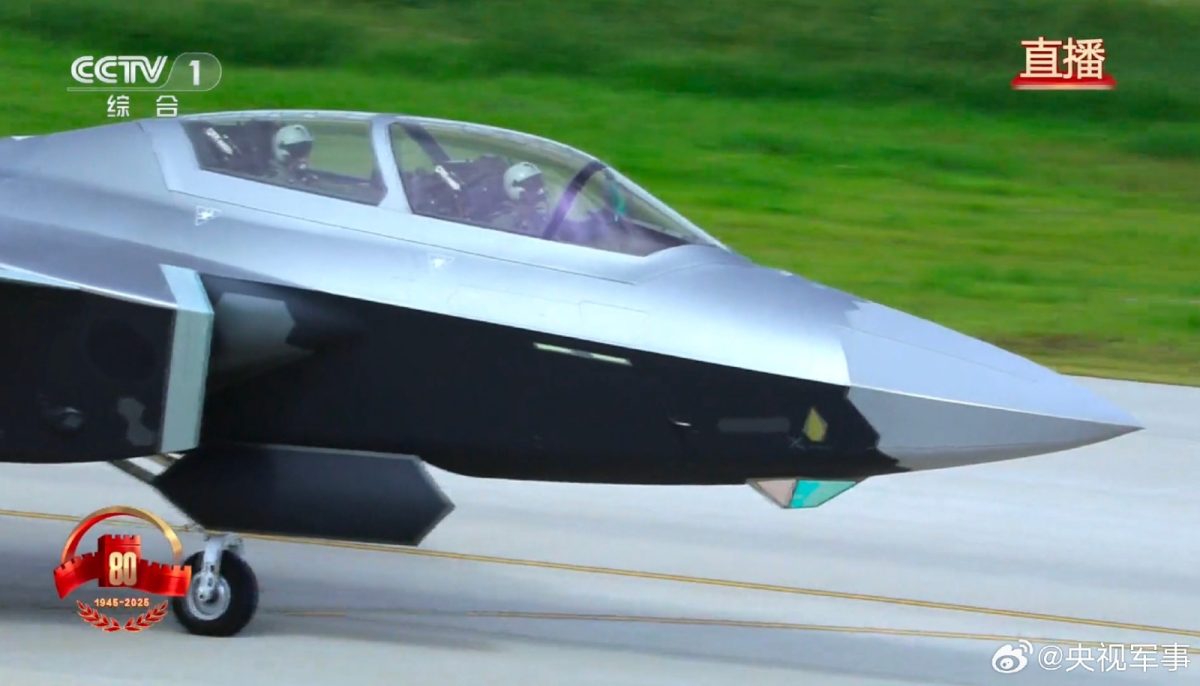
China’s subtle symbolic move, which has far-reaching strategic implications, has sparked speculation about Iran’s potential decision-making power over China, which has state-of-the-art stealth aircraft, as US President Donald Trump builds up a massive military force in the Persian Gulf to put pressure on Iran.
Last week, when President Trump ordered the U.S. Navy’s newest aircraft carrier, the Gerald R. Ford, to move to the Persian Gulf, where the Abraham Lincoln is already deployed along with nine other U.S. warships, China’s foreign attaché based in Tehran presented Iran’s air force commander with a model of a Chinese J-20 fighter jet.
On February 8, a Chinese military attaché presented a J-20 mockup to Brigadier General Bahman Behmard on the occasion of Iranian Air Force Day.
Although the deal has not been announced, it is hard to miss the timing and symbolism of China’s gesture, as it was more than just a ceremonial gesture and was meant to send a message not only to Tehran, but also to the United States and Israel.
“If China supplies Iran with fifth-generation jets, it would not only strengthen Iran’s deterrent capabilities but also signal that Beijing is willing to directly challenge U.S. sanctions,” said Dr. Farzin Nadimi of the Washington Institute.
The incident was widely reported in Iranian state media and sparked speculation that Beijing was considering exporting its latest stealth fighter jet, the J-20, to Tehran at a time when the United States is building up warships in the region.

Notably, China has always maintained that the J-20 is only for domestic use by the People’s Liberation Army Air Force, and the Chinese government has never made the fighter available for export.
Meanwhile, Israeli analyst Tal Inbar warned against reading too much into routine diplomatic behavior. “Sometimes a desk model is just that. Don’t hold your breath and watch a real J-20 in Iran.”
The question, therefore, is whether China is actually considering exporting the J-20 fighter jet to Iran, or whether its presentation of a mock-up model to Iranian air force commanders was solely intended to send a strategic message to Washington that Tehran is not isolated and that Beijing is ready to help politically, technologically, and militarily.
Iran and China strategic partnership
In 2021, Iran and China signed a Comprehensive Strategic Partnership that institutionalized defense cooperation, joint exercises, and technology exchanges as pillars of bilateral relations.
Under this framework, China has emerged as one of Iran’s major defense partners, supplying Iran with drones, missile technology, radars, and air defense systems.
Meanwhile, China, Iran, and Russia are also conducting the Maritime Security Belt 2026 naval exercise in the Strait of Hormuz.
Recently, China supplied Iran with the HQ-9B long-range surface-to-air missile (SAM) system and the YLC-8B radar.
Last month, there were reports that the Chinese government was supplying Iran with a hypersonic intermediate-range ballistic missile, the Dongfeng-17 (DF-17), which could potentially target US assets in the region.
According to reports, China is also supplying Iran with thousands of tons of sodium perchlorate, which is used to make solid propellant for intermediate-range ballistic missiles.
Iran has also expressed interest in purchasing China’s J-10C 4.5-generation fighter jet. However, no contract has been announced to date.
Meanwhile, China buys up to 95% of Iranian oil, as most countries have ruled out imports due to the threat of sanctions. After the fall of Maduro’s regime in Venezuela following the abduction by the US military, Beijing’s dependence on Iranian oil further increased.
It is clear that our two countries enjoy a strong defense partnership. But can China take this strategic partnership to a new level by exporting cutting-edge stealth fighter jets to Iran?
At this stage, that seems highly unlikely.
First, China has never offered to export the J-20 Mighty Dragon to any country, including all-weather friendly Pakistan, which imports almost 80% of its defense equipment from China.
In this sense, just as the United States has never proposed exporting the F-22 Raptor, China is closely guarding the J-20, and 18 countries have already signed contracts for the F-35 Lightning II.
In fact, China is offering a second stealth fighter, the J-35A, for export. Even if China were to consider exporting stealth fighters to Iran, the J-35A would be a more likely option.
Exporting the J-20 means there is a risk that its signature, systems, and maintenance methods will be exposed to foreign countries.
This risk is particularly acute in Iran, as it is well known that Israeli intelligence agents are deeply embedded in Iranian society.
It is worth noting that in September last year, a viral post was posted on the Chinese microblogging site Sohu lamenting that “Iran is infiltrating Iran like a sieve, and China is concerned about technology leaks.”
A common joke among the Chinese military is that selling fighter jets to Iran is like giving blueprints to Israel.
Israel’s intelligence agency Mossad has deeply penetrated all sectors of Iranian society, as evidenced by its repeated successful assassinations of Iranian nuclear scientists and military leaders.

Therefore, exporting the J-20 to Iran could mean exposing its vulnerabilities to the United States, which could be detrimental to Beijing in the Indo-Pacific theater.
Supplying J-20s to Iran could also be a logistical nightmare for Beijing. There is a problem with the fighter training of Iranian pilots.
Notably, China has recently avoided entering into a formal defense agreement with Iran, citing the potential political costs.
In addition, stealth aircraft require high-quality paint, maintenance procedures, adequate hangars, and a reliable parts supply chain. Until Beijing provides these logistics routes to Tehran, there is little point in supplying Iran with front-line jets.
Additionally, without proper training and maintenance routes, the J-20 is unlikely to reach its full potential in Iran, where it could face America’s most advanced fighter jets such as the F-22 and F-35. China is unlikely to take that risk.
Here again, Sohu’s viral post succinctly explained China’s concerns.
“Buying just fighter jets is a waste of money. Even if[Iran]imitates India’s Rafale and fights alone, it will only lose to Israel again. Modern air combat is not a ‘one-on-one duel of fighter jets,’ but a ‘battle of systems.'”
“Pakistan was able to counter India thanks to China-sold early warning aircraft, data links, and Hongqi-16 (HQ-16) air defense missiles, all of which are connected for combat,” the blog post claimed.
Iran’s ground-based radars are outdated from Europe and the United States, and its early warning systems are a Soviet relic and are not interoperable, he said. Therefore, according to Chinese experts, Iran should prioritize modern air defense systems.
“From a strategic point of view, Iran urgently needs to improve its air defense and anti-missile capabilities, not just strengthen its air force offensive capabilities. Only by improving its air defense systems can it respond more effectively to Israeli air and missile attacks.”
To deal with Israel’s F-35 stealth fighter, Iran needs to buy a Chinese meter-wave anti-stealth radar, which he suggested would allow it to “fly the American F-35 fighter naked.”
For these reasons, it is highly unlikely that China is considering exporting the J-20 to Iran or that an agreement will be announced soon.
What is far more likely is that the Chinese government is testing the waters and gauging reaction by putting it on the table without being involved in the actual deal. This is a low-cost, high-impact signal.
Perhaps China wants to send a strategic message to the United States that Iran is not alone and that Beijing is ready to support it politically, diplomatically, and even militarily.
A photo shoot in which a Chinese military attaché presented a J-20 mockup to an Iranian air force commander should be treated as a strategic communications operation rather than a sign of an actual deal.
Sumit Arawat has over 10 years of experience in news media. He has worked with Press Trust of India, Times Now, Zee News, Economic Times and Microsoft News. She holds an MA in International Media and Modern History from the University of Sheffield, UK. Author’s personal opinion. Contact him at ahlawat.sumit85 (at) gmail.com.
