


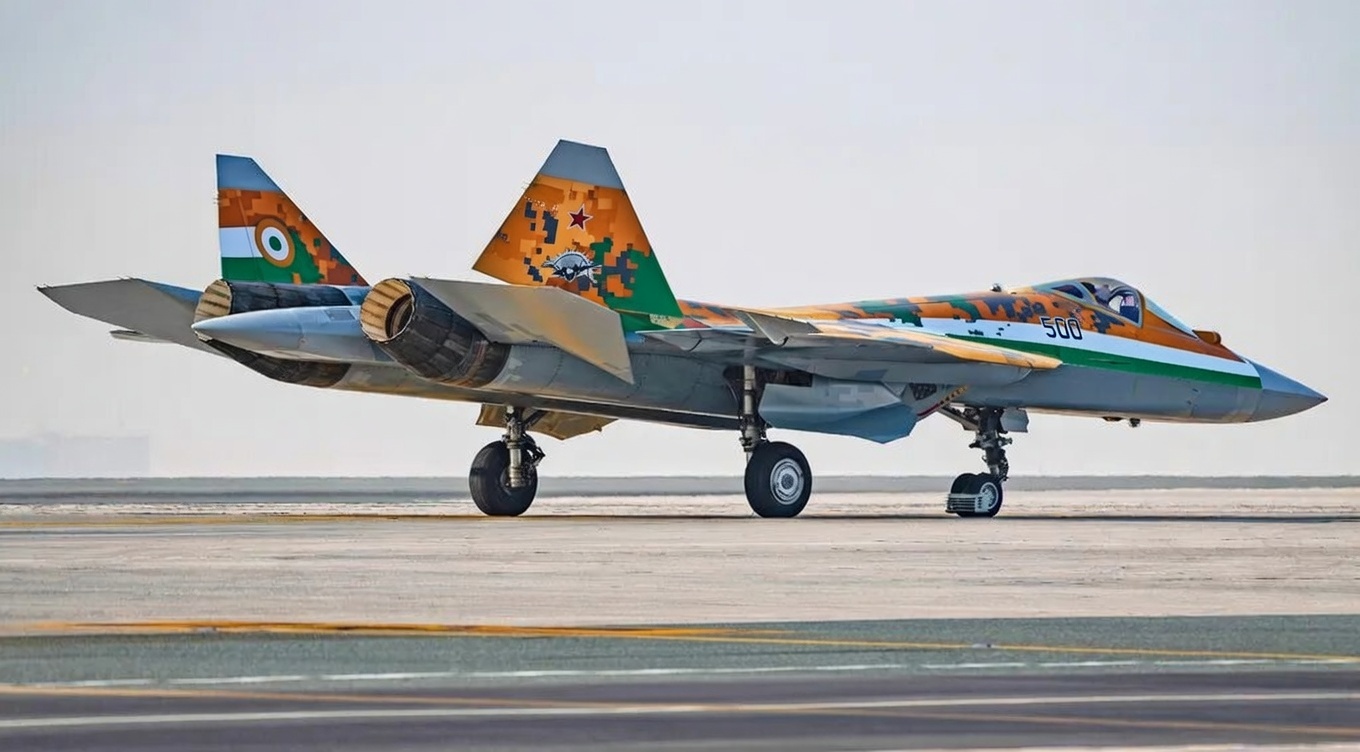
Microwave microchips for the Su-57 fighter jet and the S-500 Prometheus air defense system are scheduled to be manufactured in Russia by the end of 2027.
Sverdlovsk Oblast Governor Denis Passler recently announced that a company has begun designing and building the country’s first factory capable of continuous production of microwave microchips over the entire technology cycle.
The facility’s planned production capacity will be up to 2,000 silicon wafers per year, Passler said.
A microwave microchip is an integrated circuit (IC) designed to operate at microwave frequencies in the range of approximately 300 MHz to 300 GHz. They are used in applications such as radar, satellite communications, unmanned systems, wireless networks, and high-speed data processing.
A common example is the monolithic microwave integrated circuit (MMIC). It integrates components such as transistors, resistors, and capacitors onto a single semiconductor substrate (usually gallium arsenide (GaAs) or silicon) to efficiently process microwave signals.
These chips process ultra-high-speed data and wireless signals in real time for tasks such as signal decoding, radar tracking, and pattern recognition.
French “Crown Jewel” US company acquires major Rafale jet supplier! Are these subject to US export restrictions?
The Su-57’s N036 Bielka air radar is likely to rely on such microwave chips, as is the 96L6-CP radar of the S-350A Vityaz air defense system and the 98L6 Yenisei radar used in the S-500 and S-400 systems.
Su-57 Bielka radar
N036 Byelka (“Squirrel”) is an advanced X-band active electronically scanned array (AESA) radar system developed by the Tikhomirov Institute of Scientific Instrument Design (NIIP) for the fifth generation Sukhoi Su-57 fighter aircraft.
It serves as the aircraft’s primary fire control radar and features a nose-mounted N036-1-01 array with approximately 1,514 to 1,526 gallium arsenide (GaAs) transmit/receive (T/R) modules.
Not just S-400, India targets S-500 type system by 2030: Project Kusha – realistic or just a market strategy? OPED
This is complemented by two side-looking N036B-1-01 X-band arrays with approximately 358 to 404 T/R modules each, providing extended azimuth coverage up to ±135°. In addition, an L-band array embedded in the leading edge of the wing supports IFF and electronic warfare capabilities.
Although inferior to gallium nitride (GaN) in terms of power density and heat dissipation, GaAs substrates offer high electron mobility, low noise, and efficient operation in dense electronic environments.

Key capabilities reportedly include a detection range of up to 400 km for targets with a radar cross section of 1 square meter, simultaneous tracking of 60 air targets and 30 ground targets, and engagement of up to 16 air targets and 4 ground targets. Air-to-air mode and air-to-ground mode can operate simultaneously.
The system incorporates sensor fusion and additional dorsal elements to provide nearly 360° coverage, enhancing situational awareness, jamming immunity, and survivability in contested airspace.
China’s J-20 “fat neck” closes the gap with F-35. WS-15 engine leap forward propels Mighty Dragon into Super Cruise League
S-400 / S-500 Enisei Radar
The Yenisei radar is an advanced S-band AESA system primarily developed for the S-500 Prometi air defense system.
It features a large AESA array approximately 3 x 4 meters based on gallium arsenide technology. The radar provides long-range detection up to 600 km, high-resolution imagery, accurate tracking of both ballistic and aerodynamic targets, and strong resistance to electronic countermeasures.
It is designed for continuous, long-duration operations and also incorporates low probability of interception characteristics.
Although developed for the S-500, Yenisei can be integrated with the S-400 battery as a multi-functional fire control radar, improving missile guidance accuracy and overall system efficiency in dense electronic warfare environments.

Russia’s dependence on China
There is speculation that Russia relies on China for microchips and MMICs installed in high-end systems.
While this speculation may reflect reality, it is important to note that Russia produces MMICs domestically through companies such as Mikropribor and Istok.
However, MMIC production relies on imported parts and machinery. Production of MMICs may have been disrupted after Western sanctions were imposed in 2022, restricting Russia’s access to advanced semiconductors.
It is likely that at least some MMICs for the Su-57’s N036 Bielka radar and related radars on the S-400 (such as the 92N6E Tombstone and the integratable Yenisei) were sourced from or through China.
NATO’s second-largest military with zero combat deaths! Why does President Trump’s ‘away from the front’ jab apply so well to Türkiye?
This evidence is circumstantial. For example, in 2023-2024, China supplied about 90% of Russia’s microelectronics, including specialized chips for guidance, radar and military applications.
However, since Mikropribor’s production is centered on parts supplied from the West, China may be acting as a conduit for importing Western parts, which are primarily used in MMICs.
For example, the S-400 system relies on foreign radar boards (such as US-made RO4003C laminate) sourced from China/Hong Kong.
China has a limited number of S-400 systems, so it is unlikely that they manufacture key electronic components locally. Therefore, China is likely supplying Russia with other electronic materials such as PCB laminates.
It is important to note that Sverdlovsk Oblast Governor Denis Passler announced that the new plant will be “the first plant in the country capable of continuous production of microwave microchips over the entire technology cycle.”
When the Rafale goes “down” F/A-18 Super Hornet – destroy Boeing’s last hope! Northrop heralds the end of the U.S. Navy’s iconic jet
Impact on India
India currently operates three S-400 systems but could eventually acquire at least 10. Local manufacturing of the S-400 system is also being considered.
Meanwhile, HAL is in advanced technology negotiations with Russia’s UAC for local manufacturing of the Su-57 stealth fighter jet.
Based on the above analysis, it is highly unlikely that the IAF S-400 or Su-57 systems would be adversely affected by Russia’s likely limited and temporary dependence on Chinese electronic components.
Russia’s investment in full-cycle design and development of MMICs will ensure that India is not dependent on China.
‘Mother of all offers’: Why India could trade Su-57 with Russia, mirroring the success of MiG-21 and Su-30 MKI: OPED
Additionally, India already has design capabilities and ambitious plans to manufacture MMICs as part of its broader semiconductor drive under the Indian Semiconductor Mission (ISM). India’s design plans reportedly include an advanced 3nm node.
MMIC manufacturing capabilities are also emerging through plans that include joint US-India fabs for GaN and SiC semiconductors by 2029. India can manufacture the electronic components required for the S-400 and Su-57 systems within a reasonable period of time.
Vijayinder K Thakur is a former IAF Jaguar pilot, author, software architect, entrepreneur and military analyst. This is an opinion article. View author’s personal information Follow author @vkthakur
