
Close Menu
Karachi Chronicle
  • Home
  • AI
  • Business
  • Entertainment
  • Fashion
  • Politics
  • Sports
  • Tech
  • World

Subscribe to Updates

Subscribe to our newsletter and never miss our latest news

Subscribe my Newsletter for New Posts & tips Let's stay updated!

What's Hot

IAI delivers 350th F-35 wing to Lockheed Martin

Rye Sports staff go on strike over Olympic opening farce

Israel Aerospace Industries commemorates delivery of 350th F-35 fighter jet wing

Facebook X (Twitter) Instagram
  • Home
  • About us
  • Advertise
  • Contact us
  • DMCA
  • Privacy Policy
  • Terms & Conditions
Facebook X (Twitter) Instagram Pinterest Vimeo
Karachi Chronicle
  • Home
  • AI
  • Business
  • Entertainment
  • Fashion
  • Politics
  • Sports
  • Tech
  • World
Karachi Chronicle
You are at:Home » The economic shock of AI. Have you been here before?
Tech

The economic shock of AI. Have you been here before?

Adnan MaharBy Adnan MaharNovember 30, 2025No Comments3 Mins Read3 Views
Facebook Twitter Pinterest Telegram LinkedIn Tumblr Email Reddit
Share
Facebook Twitter LinkedIn Pinterest WhatsApp Email


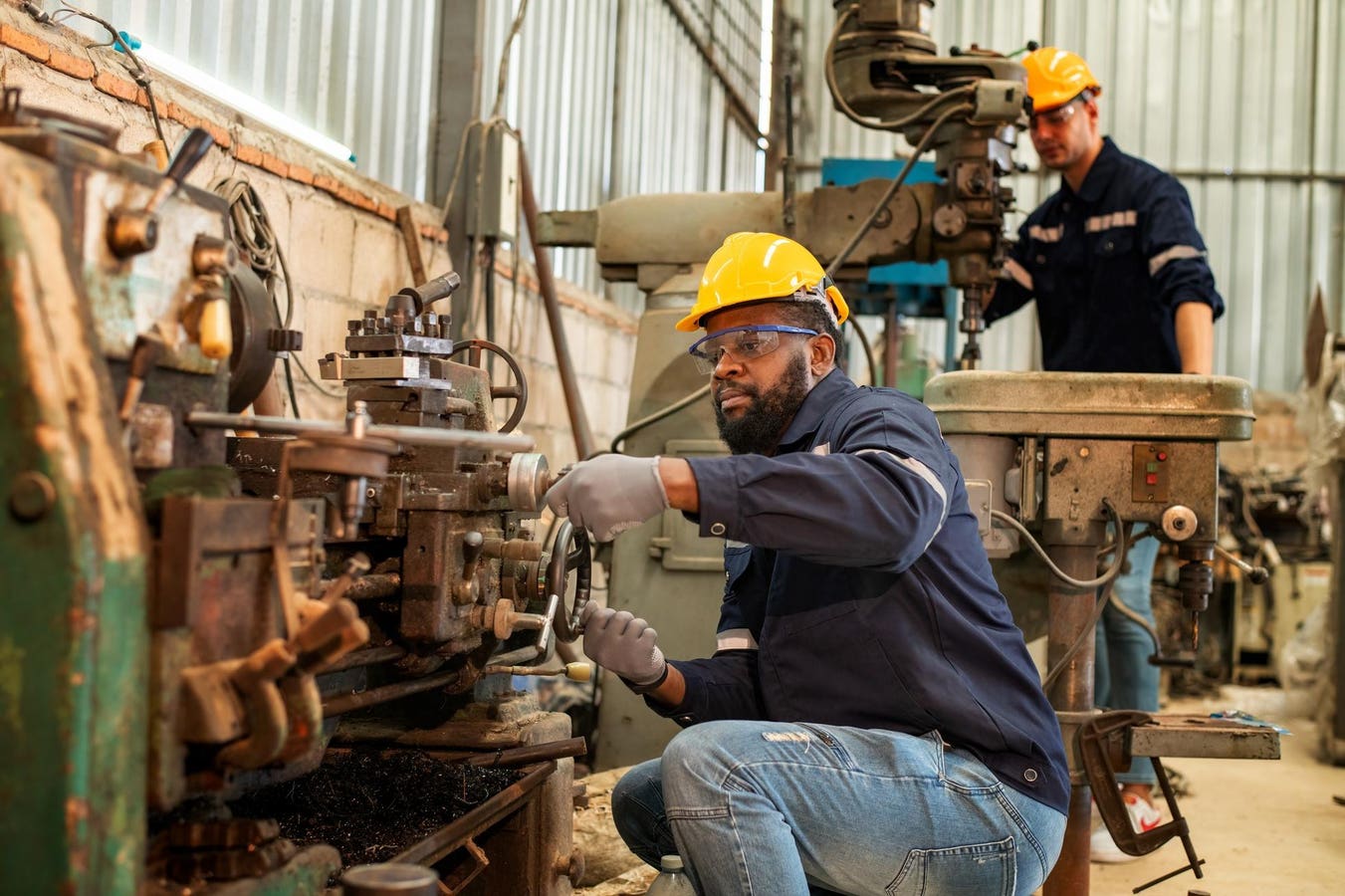
Factory industry engineer works in safety uniform and checks system of welding robot for steel electric welding by control system robot to automate industry manufacturing concept.

Today’s factory workers are engineers.

getty

There was a time when large-scale computer-driven automation replaced many jobs in the economy. It was the 1970s and 1980s, and computerized machine tools were rapidly gaining popularity, taking over the jobs of assemblers, parts makers, machinists, lathe operators, and more in industrial settings. This wave of automation was driven by intense global competition that threatened to drive many slow-moving manufacturers out of business.

In the process, the economy shifted from manufacturing labor to knowledge labor. Is there anything similar to the way artificial intelligence threatens the jobs of knowledge workers today? A team of researchers from Case Western University, Princeton University, and Brandeis University say that while there are similarities to the automation wave of the 1980s, they only go so far.

In this just-published study, economist and Case Western University professor David Klingsmith and his colleagues argue that workers may not be able to absorb the impact of the current AI wave as quickly as industrial workers in the 1980s because they had strong unions, concentrated influence, and clear retraining paths.

Look at the factory floor today compared to 40 years ago, the co-authors point out. “Modern factory floors are full of machines, but no people.
Computerized machine tools manufacture complex parts based on instructions encoded in computer programs, conveyors move parts from station to station, and robots assemble parts to create finished products. ”

Manufacturing jobs have not completely disappeared, but rather have evolved upwards. Instead of rows of low-skilled assembly line workers, today’s industrial workplaces are staffed with engineers, developers, and product experts. “Factory jobs increasingly require a sophisticated understanding of machine programming and often require a college degree.” Workers had union protection to stave off the initial shock, but they were also drawn en masse to retraining and education programs.

They previously pointed out that: “Machine tools required semi-skilled machinists to manually perform tasks to specifications,” they said. “Automation of machine tools has begun”
Widely popular in the 1970s. New computer numerical control (CNC) tools have replaced these routine tasks with detailed computer programs overseen by skilled workers. ”

Good results, at least at the time, came with increased competitiveness in the global economy. “In the metal manufacturing industry, where the use of CNC tools was high, labor productivity increased with little decline in total employment at either the industry or local labor market level,” the co-authors noted. “Labor demand has shifted from low- and medium-skill workers to college graduates.”

The combination of increased productivity, displacement from core operations, and limited overall employment places CNC between the significant automation advances of early 20th century factory electrification and the more minimal advances associated with it.
Industrial robots today. ”

In other words, the rise of factory automation in the 1980s, with an emphasis on employers providing training and education and opportunities for knowledge workers to grow their skill sets, can be seen as a long-term success story worth emulating in today’s AI environment. Things have changed, but the lesson is that advancements in advanced technology can be the tide that lifts all ships in the long run.


Source link

Share. Facebook Twitter Pinterest LinkedIn Reddit WhatsApp Telegram Email
Previous ArticleRussian S-500 air defense system: characteristics and Indian perspective
Next Article 2026 GRAMMY® Awards® Nominations Announced: Celebrating a Groundbreaking Year in Music
Adnan Mahar
  • Website

Adnan is a passionate doctor from Pakistan with a keen interest in exploring the world of politics, sports, and international affairs. As an avid reader and lifelong learner, he is deeply committed to sharing insights, perspectives, and thought-provoking ideas. His journey combines a love for knowledge with an analytical approach to current events, aiming to inspire meaningful conversations and broaden understanding across a wide range of topics.

Related Posts

Google overtakes OpenAI with remarkable growth in AI, moving from laggard to leader | Technology News

February 6, 2026

Qualcomm loses executive who held key to Custom Arm CPU push

February 3, 2026

This ‘Magnificent Seven’ stock is up 577% over the past decade and remains one of the top undervalued stocks in the S&P 500.

February 3, 2026
Leave A Reply Cancel Reply

Top Posts

20 Most Anticipated Sex Movies of 2025

January 22, 2025870 Views

President Trump’s SEC nominee Paul Atkins marries multi-billion dollar roof fortune

December 14, 2024137 Views

How to tell the difference between fake and genuine Adidas Sambas

December 26, 2024136 Views

Alice Munro’s Passive Voice | New Yorker

December 23, 202491 Views
Don't Miss
AI January 31, 2026

Surprisingly Tough Competition for Meta’s Ray-Ban

Thanks to Meta, everyone wants a piece of the AI glasses pie. While Ray-Ban Meta…

How AI assistance impacts the formation of coding skills \ Anthropic

Visual reasoning added to Gemini Flash models

Mozilla, OpenAI builds an AI “rebel alliance” against Anthropic

Subscribe to Updates

Subscribe to our newsletter and never miss our latest news

Subscribe my Newsletter for New Posts & tips Let's stay updated!

About Us
About Us

Welcome to Karachi Chronicle, your go-to source for the latest and most insightful updates across a range of topics that matter most in today’s fast-paced world. We are dedicated to delivering timely, accurate, and engaging content that covers a variety of subjects including Sports, Politics, World Affairs, Entertainment, and the ever-evolving field of Artificial Intelligence.

Facebook X (Twitter) Pinterest YouTube WhatsApp
Our Picks

IAI delivers 350th F-35 wing to Lockheed Martin

Rye Sports staff go on strike over Olympic opening farce

Israel Aerospace Industries commemorates delivery of 350th F-35 fighter jet wing

Most Popular

Anthropic agrees to work with music publishers to prevent copyright infringement

December 16, 20070 Views

chatgpt makers claim data breach claims “seriously”

July 14, 20170 Views

Everything you need to know

September 29, 20210 Views
© 2026 karachichronicle. Designed by karachichronicle.
  • Home
  • About us
  • Advertise
  • Contact us
  • DMCA
  • Privacy Policy
  • Terms & Conditions

Type above and press Enter to search. Press Esc to cancel.