


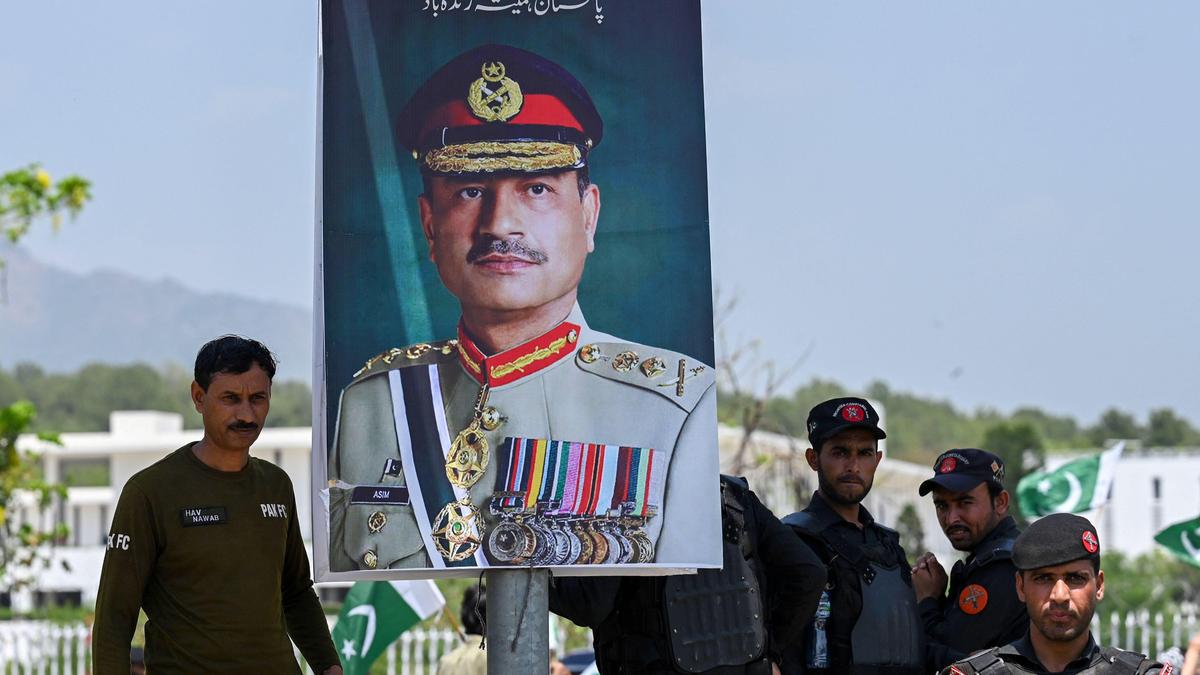
On December 4, 2025, Pakistan witnessed something familiar and disturbing. Field Marshal Asim Munir was officially appointed as the country’s first Chief of Defense Forces (CDF) while serving as Chief of Army Staff (COAS). Recent constitutional amendments have given him broad powers. Many analysts described it as a quiet coup, with no troops on the streets and no dramatic announcements, just a slow tightening of control.
By late 2025, Pakistan was already experiencing further changes at the helm. The 27th Amendment introduced legal immunity, curtailed judicial oversight, and concentrated unprecedented power in the hands of the military leadership.
General Asim Munir’s rise did not happen overnight. His stature grew after Operation Sindoor, when the nation was informed that Pakistan had gained the upper hand over India. The talks with world leaders, sometimes overshadowed by civilian Prime Minister Shehbaz Sharif, reinforced the impression that Pakistan’s elected government is no longer at the helm of the ship.
first coup d’état
The early years of Pakistan were turbulent. After partition in 1947, seven prime ministers came and went in just 11 years. Behind these political turmoil lay a society divided along ethnic, linguistic, and regional lines.
One of the main factors behind political tensions was language. The founding fathers of the nation made Urdu the national language because they believed it would be a unifying force. However, only 3-5% of the population spoke Urdu. On the other hand, Bangla was the mother tongue of over 50% of the respondents. In 1952, widespread protests erupted in Dhaka demanding recognition of Bangla and protesting East Pakistan’s systematic neglect. This mobilization on linguistic grounds gradually led to the rise of Sheikh Mujibur Rehman.
In 1958, a dramatic confrontation between Prime Minister Feroz Khan Noun and President Iskander Mirza opened the door to the military’s entry into politics. Mirza dismissed the prime minister, imposed martial law, and appointed General Ayub Khan as chief martial law chief. General Ayub had ambitions of his own. Within weeks, he ousted Mirza, sent him abroad, and took control.
General Ayub justified the takeover in his political autobiography, “A Friend, Not a Master.” “From a soldier’s point of view. There will be massive unrest across the country and the civil authorities, already groaning under the support of politicians, will not be able to deal with the situation. Only the Army can step into a breakthrough.” Thus, by imposing martial law, General Ayub thought he was shaping Pakistan’s destiny.
In 1959, General Ayub declared himself field marshal even though he had never won a war. It was Field Marshal Ayub Khan who later planned Operation Gibraltar and Operation Grand Slam in 1965. Operation Gibraltar was to rouse a local uprising in Kashmir, while Operation Grand Slam aimed to capture Akhnoor, which according to him was the “jugular vein of India”. These plans failed. The ensuing war left Pakistan reeling and General Ayub politically weak and unpopular throughout the country.
Ayub to Yahya Khan
As the 1960s drew to a close, Ayub’s rule became increasingly fragile. Economic inequality widened, protests erupted, and once-popular military rulers found themselves unwelcome on the streets. In 1969, exhausted and isolated, he handed over power to another military commander, General Yahya Khan.
General Yahya led Pakistan’s first general elections in 1970, which were a hopeful moment. However, when Sheikh Mujibur Rahman won a majority in East Pakistan and Zulfikar Ali Bhutto took control of West Pakistan, the military and West Pakistani elites refused to accept the democratic outcome. What followed was brutal repression in East Pakistan, a large-scale uprising, and finally a war with India in 1971, which ultimately led to the breakup of Pakistan and the emergence of Bangladesh. The defeat and surrender at Dhaka dealt a severe blow to Pakistan’s national psyche. In the face of public anger and opposition within the military, General Yahya resigned in December 1971.
Zia era
Zulfikar Ali Bhutto emerged as a political leader as Pakistan attempted to rebuild itself. But even Bhutto’s charisma and brilliance could not bridge Pakistan’s internal divisions. His political style alienated various groups, especially the Urdu-speaking population, who felt marginalized. Additionally, a disputed 1977 election threw the country into turmoil.
At this point, Army Commander-in-Chief Zia-ul-Haq seized power under Operation Fair Play, ousted Bhutto, and subsequently sent him to the gallows. This wound still ache in the memories of the Pakistani people.
General Zia ruled for 11 years. In photos, he was always smiling and was disciplined and ruthless. Under his regime, blasphemy laws were strengthened, jihadist ideology took root, textbooks were rewritten, and opposition was suppressed. Conversely, Pakistan’s economic growth has improved, but Military’s Ayesha Siddiqa calls it “rentier economic growth” driven by foreign aid and Afghan jihad rather than domestic forces. Smuggling networks, arms trafficking, and informal markets flourished under General Zia. It was also General Zia who planned the terrorist attack in Kashmir.
His death in a mysterious plane crash in 1988 ended the authoritarian era, but not the military’s control over Pakistan’s destiny.
The general as the chief executive
Benazir Bhutto won the 1988 elections and became the hope of a wounded nation. But army authorities soon clipped her wings, and her government collapsed within two years. The main reason was Benazir’s assertiveness and differences with then army chief Mirza Aslam Beg.
The 1990s saw a cycle of hope and disappointment. Sharif, then Benazir, then Sharif again and governments fell one after another as Pakistan struggled to define democracy. In 1999, Prime Minister Nawaz Sharif reached out to India. The image of Atal Bihari Vajpayee’s bus boarding Lahore has inspired many people across South Asia. But while leaders offered peace, Pakistan’s military had other plans. General Pervez Musharraf secretly launched Operation Koepaima (Operation Kargil), hoping to capture strategic heights in Kashmir. The operation was carried out as part of India’s peace efforts to undermine Pakistan’s credibility and destroy the credibility of General Musharraf and Mr. Sharif. By October 1999, General Musharraf overthrew the elected government.
Unlike past dictators, General Musharraf presented himself as a reformer, promoting open media, decentralization, and “enlightened moderation.” But beneath the modern surface, the military footprint remained strong. A series of crises, the suspension of Chief Justice Iftikhar Chaudhry, the siege of Lal Masjid, and Benazir’s tragic assassination have undermined General Musharraf’s support. His party collapsed in the 2008 elections and he stepped down.
From favorite to enemy
Between 2008 and 2018, Pakistan had four prime ministers, Yosuf Raza Gilani, Raja Pravez Ashraf, Nawaz Sharif, and Shahid Khaqan Abbasi, but none of them completed their terms. Civilian-military tensions remained a feature of governance.
In 2018, Imran Khan, once a favorite of the army, came to power promising reforms and justice. Many in the Pakistani military believed he would be different. But like Bhutto and Mr. Nawaz, he ultimately challenged the very institutions that had helped elevate him. The moment he tried to assert his autonomy, he was met with resistance. Imran Khan became the first Pakistani prime minister to be removed by a vote of no confidence. Shortly after, he was embroiled in a court case, stripped of his party’s electoral symbol, and imprisoned.
However, in the 2024 elections, independents backed by Pakistan Tehreek-e-Insaf won more than 90 seats, a testament to his enduring popularity. Still, a coalition led by Shehbaz Sharif formed a government with tacit support from the army.
Imran Khan remains popular but powerless, a reminder that public support alone does not guarantee political survival in Pakistan.
Why does that pattern continue?
Since its inception, Pakistan’s civilian government has struggled to control the country. Jinnah’s early loss, deep ethnic and linguistic rifts, corruption, radicalization, geopolitical entanglements, and the persistent weakening of civilian institutions all allowed the military to emerge as the country’s most cohesive and powerful institution.
The rise of General Asim Munir is therefore not unique. It’s just another chapter of the same story.
Until Pakistan rebuilds its political system, mends internal divisions, and strengthens civilian rule, this cycle will continue, and the military will remain a quiet, steady, and ever-present presence, shadowing every government.
Dhananjay Tripathi teaches International Relations and Tavseer Shams is pursuing his Masters in International Relations at the University of South Asia, New Delhi
