


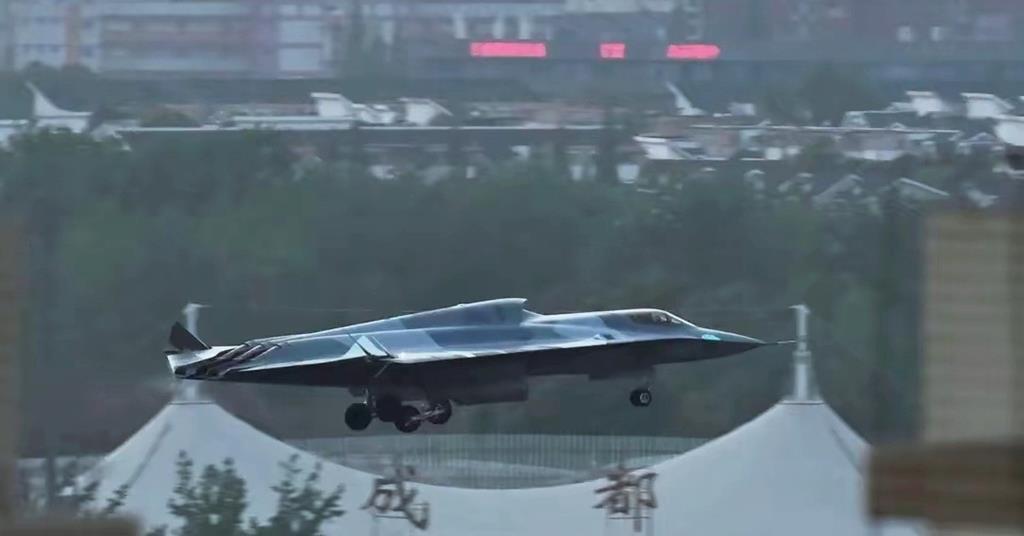
The U.S. Department of the Army’s latest report on China’s military capabilities highlights significant advances in air power.
The annual report provides general updates on the capabilities of Chinese military aircraft, but provides few details.
The paper notes that China began testing a pair of “sixth generation” aircraft in December 2024, referring to tailless jets tentatively called the Chengdu J-36 and Shenyang J-50/XDS. The assessment claims the two jets are in early stages of development and could be operational by 2035.
“Once operational, the sixth-generation aircraft will likely be suitable for a variety of combat missions, including air-to-air and air-to-ground missions, and will also be suitable for guiding unmanned aircraft in combat missions,” the report said.
The report also states that the Xi’an KJ-3000 Airborne Early Warning and Control (AEW&C) aircraft also conducted its first flight in 2024.
“The KJ-3000 will likely be the world’s first model to use digital radar, enabling anti-jamming, passive detection, and target identification,” the Pentagon report said.
All modern active electronically scanned array radars are digitally controlled, but the report’s ambiguous “digital radar” language suggests that the KJ-3000 may employ a more advanced software-defined radar architecture. This could enable digital beamforming, improve immunity to jamming, and also enable simultaneous monitoring and passive sensing.
In the naval aviation field, the report states that China’s third aircraft carrier, CNS Fujian, completed its first sea trials, and its first two aircraft carriers, Liaoning and Shandong, conducted twin carrier operations for the first time.
The report also notes improvements in China’s unmanned aerial vehicle (UAV) capabilities, rating the WZ-9 Divine Eagle UAV as “semi-operational” after its deployment to the South China Sea.
The Chinese government also continues to make advances in aircraft engines.
“Engine progress will likely be gradual as China continues to work steadily to resolve the various technological barriers that have historically slowed advanced propulsion projects,” the report said.
Additionally, the report also notes China’s progress in the field of artificial intelligence. The 2024 Zhuhai Air Show highlighted China’s ambitions to use AI to control a variety of UAVs, including loyal wingmen intended to accompany manned jets, such as the two-seat version of the Chengdu J-20, which appears to be optimized for managing unmanned aircraft operations.
Beijing is also positioning its fighter jets for export, appealing to its air force, which is constrained by political restrictions and the lower prices offered by Western stealth jets. Although unanswered questions about capabilities and integration remain, China’s willingness to transfer technology and ease end-use restrictions could make its fighter jets attractive to a narrow but growing market.
