


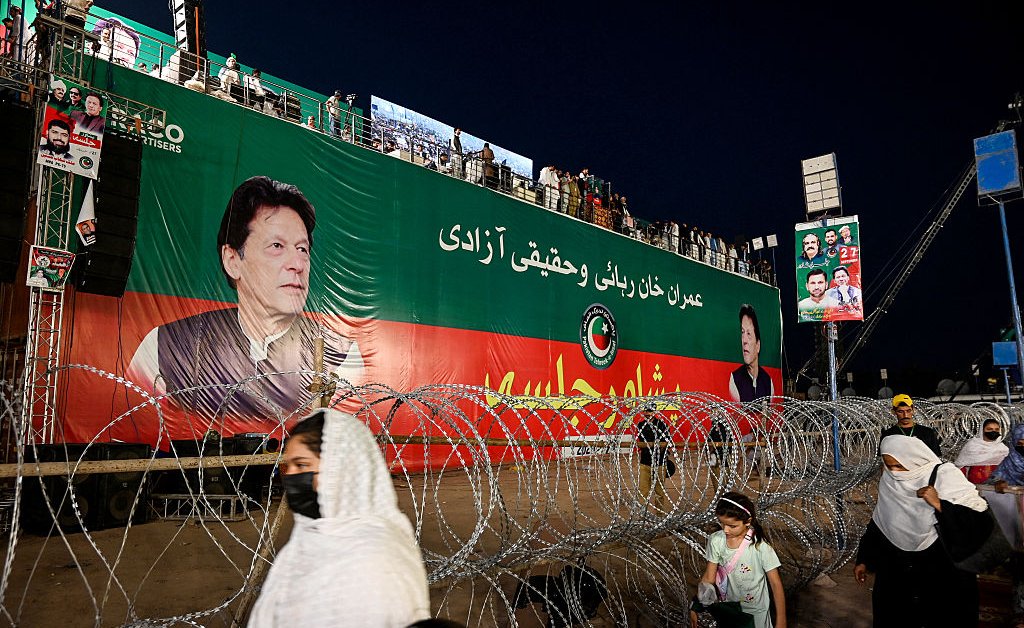
Unconfirmed rumors that the country’s former prime minister Imran Khan has died in prison are exploding on social media, despite protests from Pakistani authorities. Khan, who has been imprisoned since 2023, has not been allowed access to his family or lawyer in recent weeks, sparking speculation about his fate. As a result, assurances from Pakistani authorities that he is in good health have done little to quell protests by his family and supporters who have demanded more concrete proof of his survival.
Although the rumors about his death seem to be greatly exaggerated, the Pakistani establishment’s desire to erase Khan from the public imagination is very real and can be fact-checked on a weekly basis. He has already been sentenced to 14 years in prison and faces multiple prison terms in more than 150 cases in which he was charged with crimes ranging from theft of state gifts to inciting violent attacks on military headquarters.
Mr. Khan’s ascent to power may have been miraculous, but his path to a cramped prison cell was always foretold, at least to those with even a passing knowledge of Pakistan’s history. Every elected prime minister of Pakistan over the past 50 years has had to be imprisoned at some point in their career. It’s almost a job requirement. Zulfikar Ali Bhutto, Prime Minister of Pakistan from 1973 to 1977, was hanged in 1979 after being charged with murder. Forty-five years later, in 2024, Pakistan’s Supreme Court declared that the noose around his neck may have been the result of a miscarriage of justice.
Since Bhutto’s execution, all of Pakistan’s prime ministers have come out of prison alive, and some have returned to power. There’s a simple equation. At some point during their incarceration, they make an agreement with military authorities to go into exile and wait for conditions to improve. While Pakistan’s military has strategies for dealing with a prime minister who has begun to take his title seriously, politicians have their own tricks up their sleeves to escape from their cells.
This is why Pakistani political observers expected Khan to be jailed. The only question was how it would play out. After weeks of isolation in solitary confinement, will he beg for a deal and eventually defect to London? Or will Khan, a world-class athlete, a fitness fanatic and a very stubborn man who believes only in his own destiny, fight to get out of his own way?

After serving two years in prison, Mr. Khan remains defiant and remains Pakistan’s only vocal political opponent. He is also the biggest thorn in the side of the military and government. Through lawyers, party officials and a raucous social media team, he gets his message across, denouncing his captors and ranting about corruption in Pakistan’s ruling coalition.
The military and government have tried to erase Mr. Khan from television bulletins, social media and the public’s memory. His photo is not allowed to be shown on television in Pakistan. It is forbidden to even say his name. Some television news networks refer to him as “Kasim’s father”, after one of his two sons, Kasim Khan, who is in the UK. When his sons announced in June that they wanted to go to Pakistan to campaign for his release, they were threatened with arrest. Pakistani authorities are currently cutting off contact with Mr. Khan’s family and lawyers, despite court orders.
Imran Khan had planned for such a scenario. When he entered politics in the mid-1990s, when his entire party could fit in his living room, he was seen lecturing his supporters on how to deal with the military. All that is needed is 20,000 troops in each of Pakistan’s four largest cities, but these generals won’t know what to do. Then I learned that the path to power in Pakistan always goes through the military command. For a while, the same generals, tired of electing a prime minister by turning prison doors in turn, looked at him with reverence and helped him rise to power by disqualifying or throwing his opponents into the same prisons in everyone’s eyes.
When he finally fell out with his generals, Khan set out to unleash the mob of his imagination. His followers looted the general’s official residence and attacked military installations. The generals considered this an attempted coup and decided to do the same as the perpetrators of the failed coup. Khan was arrested. He seemed convinced that the crowd would arrive and break down the prison doors and he would be free. Crowds tried to rally, and generals erupted in anger. Khan’s party activists were abducted, and its leaders were cornered, bribed, and beaten into submission. Khan was left with a small group of family members and supporters who negotiated weekly prison meetings. Now even that luxury has been denied.
Meanwhile, in an unprecedented power grab, Pakistan’s military commander, General Asim Munir, has consolidated his power and recently engineered constitutional changes that also give him command of the navy and air force, extend his term of office from three to five years, give him lifelong privileges in uniform and lifetime immunity from prosecution. The generals reduced even the limited need for a submissive prime minister.
As this power grab extended beyond the walls of his cell, Khan must have realized the limits of his dreams of popular uprising. After all, he is 73 years old, and the current military regime has taken away any bargaining chip the former prime minister could use to get out of prison. In fact, even his opponents claim he’s not signed because of the lack of offers.
Since Mr. Khan was imprisoned, all levers of political power have collapsed. His supporters have complained to the court that judges are too busy protecting their jobs. They appealed to international human rights organizations and set up vigils in Barcelona and London. His supporters in the United States have been lobbying Congress and President Donald Trump for help with his release, but some may say it’s a futile effort, given that Trump recently called Munir “my favorite field marshal.”
Khan’s political opponents back home, all escapees from the same prison he is in, have their noses cut off to insult his handsome face. After recent constitutional reforms expanded Munir’s powers, they effectively ceded what little political influence they held to the military. They seem to be saying that if you keep him, he’ll do everything you ask him to do. Unsurprisingly, in a country with a long history of coups, the military is happy to have its hand-picked puppets do its bidding without actually declaring military rule.
The legend of Imran Khan was born in 1992 when he led Pakistan’s ragtag cricket team, which had been on a losing streak, to victory in the Cricket World Cup. He inspired his team and inspired them to fight like a cornered tiger. He was wearing a T-shirt with the same slogan. The military now believes the old tiger has been kept in a cage and the key has been thrown away. Speculation about his health and well-being may be wrong, but this much is clear. They now want to drown out his weekly screams and rants from the cage.
