


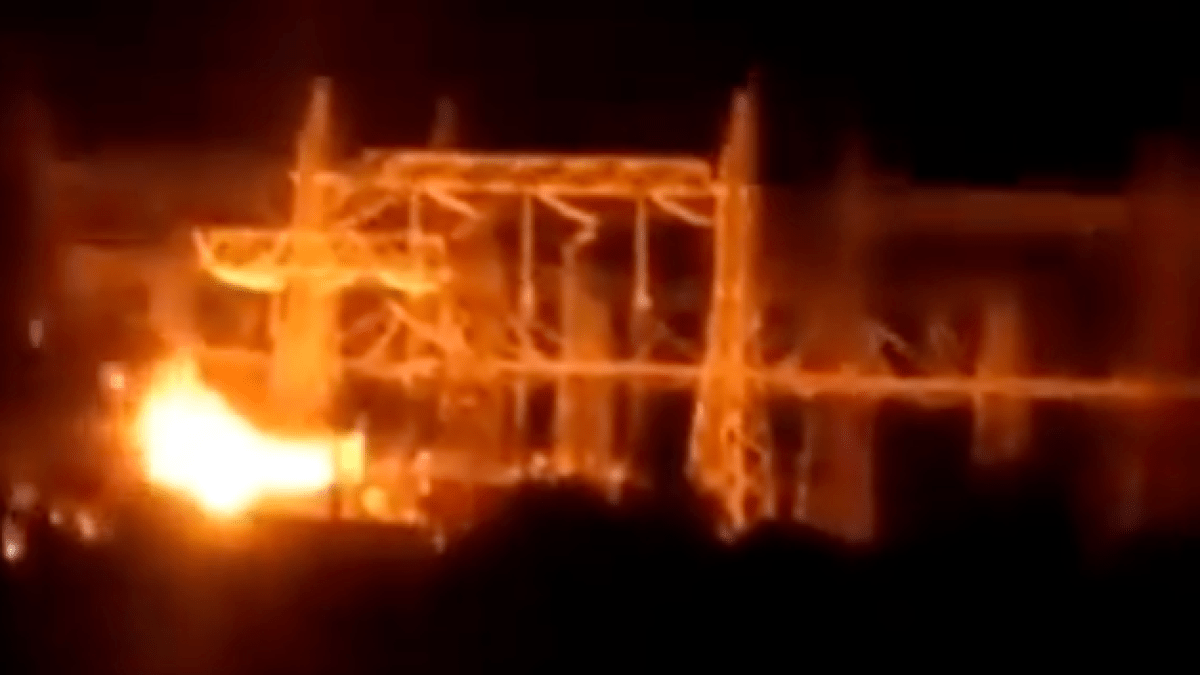
A drone attack on a major power plant in eastern Sudan has plunged major cities across Sudan, including the capital Khartoum and the coastal city of Port Sudan, into darkness.
Flames and smoke rose from the facility in Atbara, Nile state, on Thursday. The facility is controlled by the government-affiliated Sudanese Armed Forces (SAF) and has come under attack by the Rapid Support Forces (RSF) paramilitary group in the ongoing civil war that has torn the country apart.
Recommended stories
list of 3 itemsend of list
Video footage of the power plant going up in flames has been circulating on social media and verified by Al Jazeera.
Officials at the plant said two civil defense personnel were killed while trying to extinguish a fire that broke out after the first attack, adding that rescue workers were injured when a second drone collided with them as they tried to extinguish the fire.
Al Jazeera correspondent Mohamed Wal in Port Sudan reported that residents initially thought they had experienced a periodic power outage, but learned it was related to an incident in Atbara, about 320 kilometers (about 230 miles) north of Khartoum.
He added that such attacks have become more frequent in Sudan’s war.
“We have seen this situation many times this year and last year. RSF drones are flying thousands of kilometers across Sudan because they see this as a way to weaken the government and prove to the people that this military junta cannot protect them,” Val said.
The attack marks the latest escalation in a devastating drone campaign that has killed at least 104 civilians across Sudan’s Kordofan region since early December. The deadliest strike hit a kindergarten and hospital in Karogi, South Kordofan, killing 89 people, including 43 children and eight women.
Six Bangladeshi peacekeepers were killed in a drone attack on a Bangladesh peacekeeping base in Kadugri on December 13, prompting UN Secretary-General António Guterres to warn that targeting peacekeepers “may amount to a war crime under international law.”
The next day, Dilling Army Hospital came under fire, killing at least six people and wounding 12, many of them medical staff.
Drones have been used extensively by both the SAF and RSF in recent months.
According to the African Center for Strategic Studies, a US-based think tank, 484 drone attacks occurred in 13 African countries in 2024, with Sudan accounting for 264 of them, more than half of the total on the continent. By March 2025, the intensity had skyrocketed further, with the SAF claiming to have shot down over 100 drones in just 10 days.
Sexual violence is ‘alarmingly escalating’
Sudan was plunged into chaos in April 2023 when a power struggle between the SAF and RSF exploded into fighting. According to some estimates, more than 100,000 people died in the war, but the true toll remains unknown.
The conflict has caused what the United Nations calls the world’s largest humanitarian crisis, with more than 14 million people displaced and at least 30 million in need of critical assistance. More than 40,000 people have been evacuated in North Kordofan alone, with civilians still trapped in the besieged city.
For the third year in a row, Sudan topped the International Rescue Committee’s emergency watch list, announced Tuesday, as global humanitarian funding falls by 50 percent. A Thomson Reuters Foundation poll of 22 aid agencies has named Sudan the world’s most neglected crisis in 2025.
More than 1,600 people have been killed in 65 attacks on health facilities across Sudan this year, WHO Director-General Tedros Adhanom Ghebreyesus said on Wednesday. “With every attack, more people are deprived of medical services and medicines,” he said.
Seif Magango, spokesperson for the United Nations Human Rights Office, also told Al Jazeera on Wednesday that sexual violence has also “escalated alarmingly” and that women are bearing the greatest cost of the conflict. The situation in El Fasher is particularly horrifying, he said, saying women face “gang rape at the same time as they are trying to escape murder and bombs.”
The heaviest fighting has now moved from Darfur to the central region of the country, which is divided into areas controlled by the RSF and SAF.
A report released Tuesday by the Yale School of Public Health’s Humanitarian Lab found that RSF forces engaged in a “coordinated, weeks-long campaign to conceal evidence” of mass murder in El Fachel through burial, incineration, and removal of bodies after the city fell in October.
