


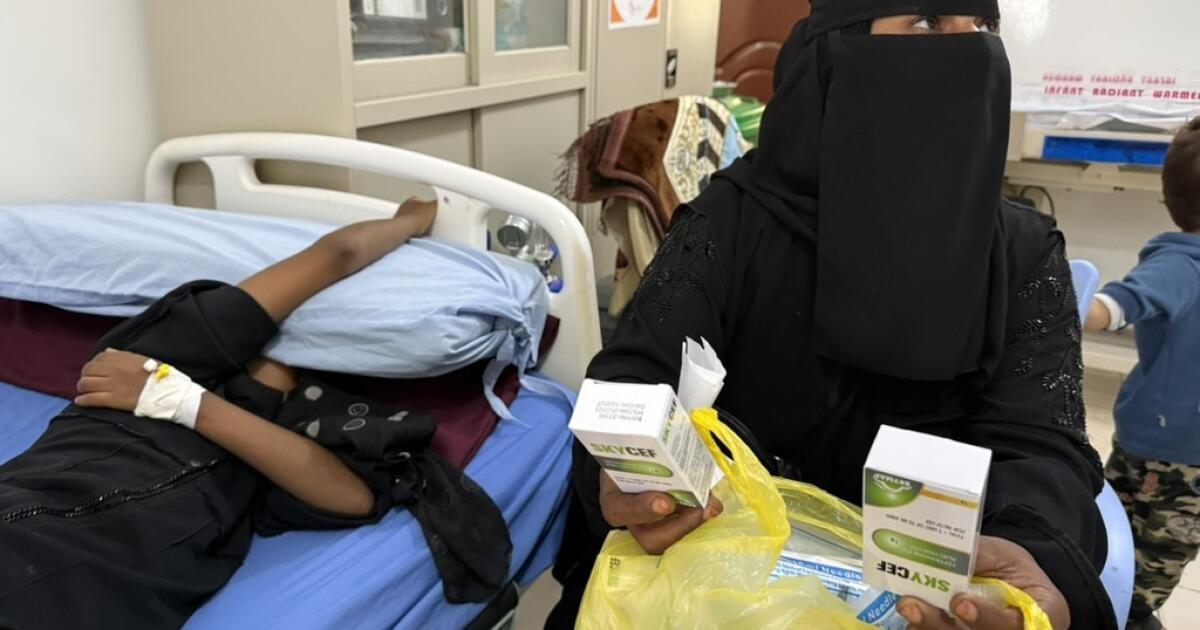
Al Qawd, Yemen — In the cramped examination room of this small village clinic, Rania Moussa lies on her side, her eyes covered with a pillow, her thin, childlike frame belying the fact that she is only 13 years old. It had been several days since she received the powerful antibiotic injection she needed to manage her condition, a type of anemia.
But the clinic, which previously offered it for free, now had nothing to offer. And aid is unlikely to come soon, as aid has been cut since the U.S. froze aid last year. Rania’s mother said her daughter couldn’t do anything without medication.
“She can’t walk, she can barely move. I had to carry her here. Before, we could get vaccinated, but now there are no syringes in any clinic. We have to buy syringes at the pharmacy,” said Jamila Omar, Rania’s mother. “We can barely buy food, let alone medicine.”
Omar somehow scraped together money for antibiotics, which were administered by clinic staff.
A year after the U.S. Agency for International Development was dismantled at the hands of Elon Musk and his so-called Department of Government Efficiency (DOGE), the debate over its closure could devolve into a political point-scoring game, with supporters and opponents of the Trump administration taunting each other about savings or lack thereof.

Remains of the U.S. Agency for International Development sign on the facade of the Ronald Reagan Building and International Trade Center in Washington, DC, December 29, 2025.
(Brendan Smialowski/AFP via Getty Images)
But it is here, in the dusty clusters of concrete block houses and dilapidated buildings that make up Al Kawd, that the real-world impact of these cuts is most clearly felt.
“You feel helpless,” said Alida Fadli, 53, a medical assistant who manages the clinic, as she shifted her pillow to look at Rania’s face.
“Imagine your son or daughter disappearing before your eyes,” she said. “What do you think that feels like?”
Fadli pointed to several boxes containing basic medical supplies left in a corner.
“This was the last shipment and it arrived over nine months ago,” she said. “We try to stretch them as much as possible.”
The decline in Yemen reflects a broader destruction of foreign aid around the world. The United States has committed $3.4 billion in global aid in 2025, just a portion of the $14.1 billion funded under President Biden. This includes funding from USAID and other US organizations.
And that amount is only decreasing. Late last year, the Trump administration announced $2 billion for U.N. programs in 17 countries in 2026, but Afghanistan and Yemen were specifically excluded.

Rabiy Nasr, a nurse, treats a child’s wounds at a hospital in Yemen’s Abyan province. Her injury did not require stitches, which was fortunate as the hospital was running low on sutures and surgical threads.
(Navi Bros/Los Angeles Times)
Other rich countries are following suit, with Germany cutting its humanitarian budget by more than half in 2026 compared to the previous year. France plans to cut development aid by nearly 40%, and the UK plans to reduce aid spending from 0.5% to 0.3% of gross national income by 2027.
The Trump administration offered a variety of justifications for cutting foreign aid. President Trump claimed there was “billions of dollars in waste, fraud and abuse,” while DOGE officials boasted about cost savings. Secretary of State Marco Rubio said USAID is not serving, and in some cases harming, “the core national interests of the United States.”
Administration officials did not provide any evidence of corruption and cited examples of wasteful spending that turned out to be inaccurate, such as Trump’s claim that $100 million was spent on condoms for the Hamas militant group in Gaza.
In any case, observers say less than 1% of the federal budget was devoted to foreign development assistance during the Biden administration.
Last year, the United States cut funding to Yemen from USAID and others from $768 million to $42.5 million, half of the country’s 2024 humanitarian budget. As a result, 453 health facilities across the country, including hospitals, primary health centers and mobile clinics, face partial or imminent closure, the United Nations said.
In July, the prestigious British medical journal The Lancet published a study that estimated that 14 million deaths could occur worldwide by 2030 due to USAID’s budget cuts. This estimate is based in part on the lifesaving effectiveness of USAID’s past efforts in food security, HIV treatment, health care, and other services.
The cuts are hitting Yemen hard, a country already untroubled by tragedy. Yemen has been the scene of the world’s worst humanitarian disaster for years, a brutal civil war that began in 2014 when Iran-backed Houthi rebels captured the capital and spurred a ferocious offensive by the Saudi-led coalition.
Yemen’s devastation has since been surpassed by other conflict areas, but the United Nations says 19.5 million people, just under half the population, will need humanitarian assistance by 2025, the majority of them food insecure.
That number is expected to rise to 21 million this year as political upheavals continue across the country. The Trump administration’s designation of the Houthis as a foreign terrorist organization in 2025 has made the situation even more difficult.

A soldier walks in front of the U.S. Embassy in Sanaa, Yemen, on Wednesday.
(Osama Abdulrahman/AP)
The designation effectively makes it illegal to deliver aid to Houthi-held areas, where 70% of the population lives, humanitarian workers said. At the same time, the Houthis detained 73 UN staff and seized vehicles and communications equipment, rendering the UN incapacitated.
Julian Harnais, the United Nations Resident Coordinator in Yemen, said: “At the same time as conflict-induced chaos and growing humanitarian needs, a difficult funding environment is constraining delivery.” “So all the conditions are in place for a very difficult year.”
For Yemeni aid organizations that relied on U.S. aid, the focus shifted to preserving what was left of their operations.
One aid worker, who spoke on condition of anonymity for fear of jeopardizing the remaining aid flow, said the organization he worked for had closed one of its two offices, laid off 250 of its 300 employees and halted support to dozens of health centers. The organization’s portfolio has shrunk from approximately $32 million to $2 million.
“Yes, there are other donors from Europe and Canada, but that’s less than 5% of what Americans donate,” he said.
Some organizations are trying to tailor their proposals to Washington’s regional priorities, such as countering Iran and al-Qaeda or eliminating provisions that were effectively banned under the Trump administration.
“Anything that focuses on gender, feminism, LGBT protections, any statement that includes any of those concepts will not be approved,” he said.
To give you an idea of what a year can bring, in January last year, before the aid cuts, Mr. Fadli was trying to extend the hours at Al Qawd clinic from 12-hour shifts to 24-hour shifts.
Already, three doctors – one obstetrician and gynecologist and two general practitioners – travel 52 miles every day from Aden, the main city in southern Yemen, to al-Qawd, treating around 300 patients each day. Medical assistants selected from local village women were paid $100 a month and trained to work in clinics and serve the needs of their communities.
The clinic had enough basic medicines for three months, and funds to procure specialty medicines for patients with complex illnesses.
“People come here because they don’t have money, but before we can offer them a solution to their problems,” said Dr. Umaima Jamil, a 37-year-old obstetrician and gynecologist who is the clinic’s last remaining doctor. She comes only once a week, and her expenses are paid for with funds the clinic scrapes together.
Jamil said he makes a diagnosis, prescribes medicine, and then sees patients come back with the same symptoms.
“I ask them, ‘Did you get your medicine?’ And they say they can’t because they don’t have the money,” Jamil said.
“It’s natural to be frustrated, but I don’t know what to do. It’s out of my hands.”
The impact of such a significant reduction in aid is not limited to small facilities. They extend to major medical institutions such as Al Rajhi, the main hospital in Abyan province, serving more than 30,000 patients each year.
Children are dying, and many more will die later this year.
— Julian Harnais, UN Resident Coordinator for Yemen
Dr. Muhsen Abdullah, a surgeon who heads the emergency room, spoke wearily of a hospital ward where there are no surgical threads or sutures and anesthesiologists are forced to buy their own anesthesia for patients.
“Perishable surgical supplies, antibiotics, and even iodine and rubbing alcohol have to be purchased externally by patients before undergoing surgery. That’s ridiculous,” he said, adding that some patients have postponed surgeries because they can’t afford post-operative care.
All around him there were further signs of devastation. They included an X-ray examination table with a non-functioning backlight, and an ultraviolet sterilizer that had been out of commission for several months and was covered in dust.
Humanitarian organizations operate under extremely tight budgets, so there is little they can do when an outbreak occurs. Even if infections can be detected in the first place, much of the information depends on health centers reporting outbreaks.
“Currently, there are no reports. Zero,” said an aid worker. For example, cholera cases in Yemen appear to be lower than last year, but the number of suspected cases is much higher, he said.
“How do we know in the first place? There are no kits to test for it.”
In Al Kawd, Fadli and Jamil have already detected several cases of cholera in the village. They said this was a frightening prospect after dozens of people died last year from diseases transmitted by infected water, most of them children. But with no money for quarantine or medicine, there is not much that can be done, and he expects the outbreak to get worse.
This is in line with predictions from U.N. Resident Coordinator Harnais, who said aid organizations in Yemen expected an increase in epidemics “that we will not be able to control” and an increase in mortality and morbidity, particularly affecting young children.
“Children are dying and many more will die later this year,” he said. And once such an infection occurs, there is no guarantee it will stay in Yemen, he added. “Epidemics don’t stop at borders.”
This month, the United States completed its withdrawal from the World Health Organization, a decision that the group said “made both the United States and the world less safe.”
Many in the aid community acknowledge that USAID is not perfect, and understand complaints that it could be used to promote ideas that the Trump administration has criticized as “woke.”
But they still lament the setback in their work. Some likened this to the sudden withdrawal of the United States from Afghanistan, leaving open field for the Taliban to destroy all USAID projects.
“You could say USAID was unsustainable, but there’s also an argument that we shouldn’t turn off the tap completely,” the aid official said, adding that his employer has been working in Yemen since 1994.
“This move undid decades of work.”
