


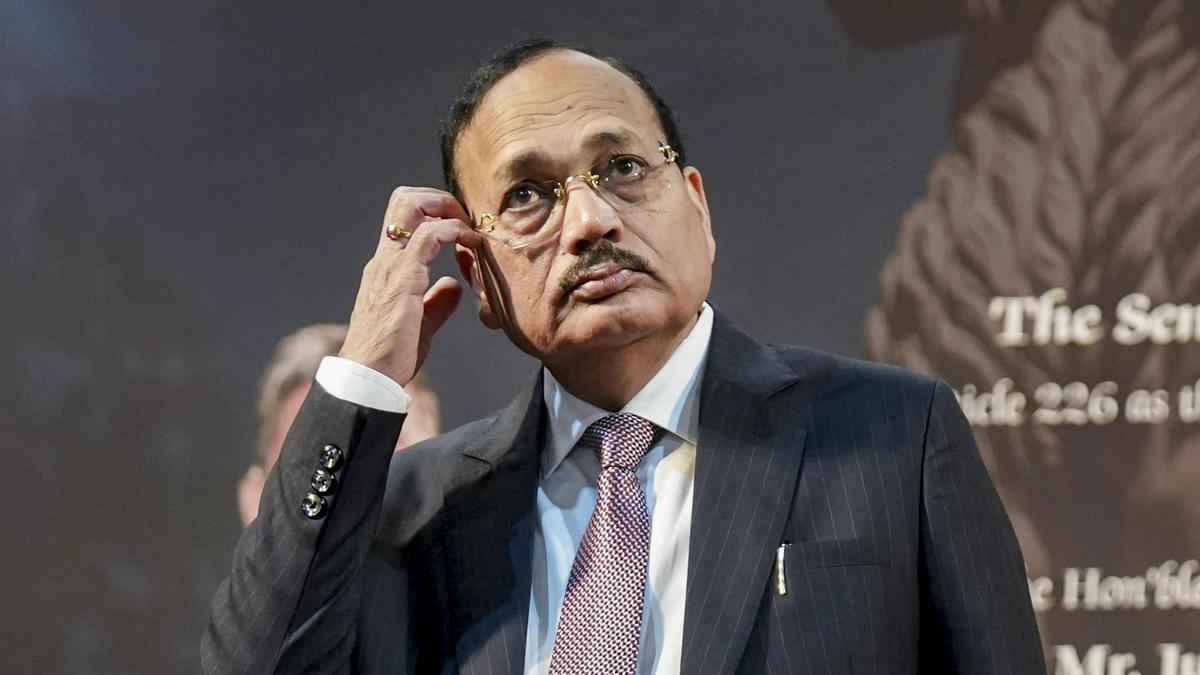
Chief Justice of India (CJI) Surya Kant said the France-India partnership is not a luxury but a lifeline in a world where forces of turmoil and geopolitical tension threaten to destabilize the very framework of international cooperation.
Speaking at the India-France Legal and Business Conference on Friday (January 30, 2026), the CJI said the relationship between the two countries has long gone beyond purely diplomatic relations and is a multidimensional structure that encompasses everything from the sacredness of defense and security cooperation to the shared pursuit of sustainable growth and advanced technology.
“We are witnessing an incredible acceleration in bilateral trade, with the value of this trade more than doubling over the past decade, soaring from $6.4 billion in 2009-2010 to an impressive $15.11 billion last year,” he said.
Speaking on the theme of “Cross-border Dispute Resolution: Courts, Arbitration, and the Indo-France 2026 Year of Innovation,” Justice Kant said, “The relationship between France and India is not a product of convenience, but a bond forged over centuries. “Today, standing on the shoulders of this history, we face a world transformed by uncertainty. The forces of turmoil and geopolitical tension threaten to destabilize the very framework of international cooperation.” Globally, the France-India partnership is not a luxury, but a lifeline. ”
He added that both countries have complementary strengths, united by a common belief in democracy, the rule of law, and the pursuit of a peaceful and just world order.
“As we stand on the precipice of the Year of Innovation in 2026, we are no longer just building nests, we are mapping the skies in which we will fly,” he said, adding that India and France are entering a new phase of innovation this year, underpinned by dispute resolution architectures that are proactive rather than reactive, principled rather than adversarial, and durable rather than just efficient.
The CJI highlighted that a promising avenue lies in the establishment of a joint arbitration and conciliation committee comprised of experts trained across civil law and common law traditions.
He said, “Such panels will bring not only the technical excellence but also the cultural and jurisprudential fluency necessary to resolve disputes that traverse legal systems as seamlessly as they traverse markets.”
Justice Kant added that deepening the institutional partnership between India’s arbitration centers and the Paris-based institution is equally important, adding that through common procedural standards, joint training initiatives and joint management procedures, these collaborations can create a forum for dispute resolution that is globally credible and at the same time context-sensitive.
The CJI said that in the Indian context, Arbitration Act, Conciliation Act and Commercial Courts Act come together to form a coherent ecosystem of arbitration for binding resolution, mediation for consensual settlement, and specialized courts for supervision and enforcement.
He added that judicially, the Supreme Court has repeatedly emphasized its pro-arbitration position, reaffirming that arbitration clauses should be interpreted liberally and that technical objections should not undermine the parties’ clear intent to arbitrate.
He said, “Indian courts have played an important role in reinforcing the fundamental features of arbitration, particularly the principle of party autonomy. This remains the backbone of India’s arbitration process, which aims to give parties the widest possible freedom to shape procedures that reflect their needs and commercial realities.”
The CJI asked the gathering to identify commonalities that bridge the gap between the Ganges and the Seine, saying the Ganges, sacred to millions of people, flows from the icy peaks of the Himalayas and nurtures life, faith and culture in the plains of India, while the Seine winds gracefully through France, rocks the heart of Paris and has inspired artists, philosophers and dreamers for centuries.
“One may seem like a moving spiritual pilgrimage, the other a poetic lifeline of art and romance. But beneath these apparent differences lies a harmony of purpose. Both rivers are storytellers. Along their banks civilizations bloom, kingdoms rise, markets flourish. It flourished and the community found its rhythm. Each river reflects the aspirations of its people and is not only a source of food but also a vessel of identity. France and India are the inheritors of a civilization that has made an invaluable contribution to art, philosophy and the human spirit,” he said.
issued – January 31, 2026 12:10pm IST
