


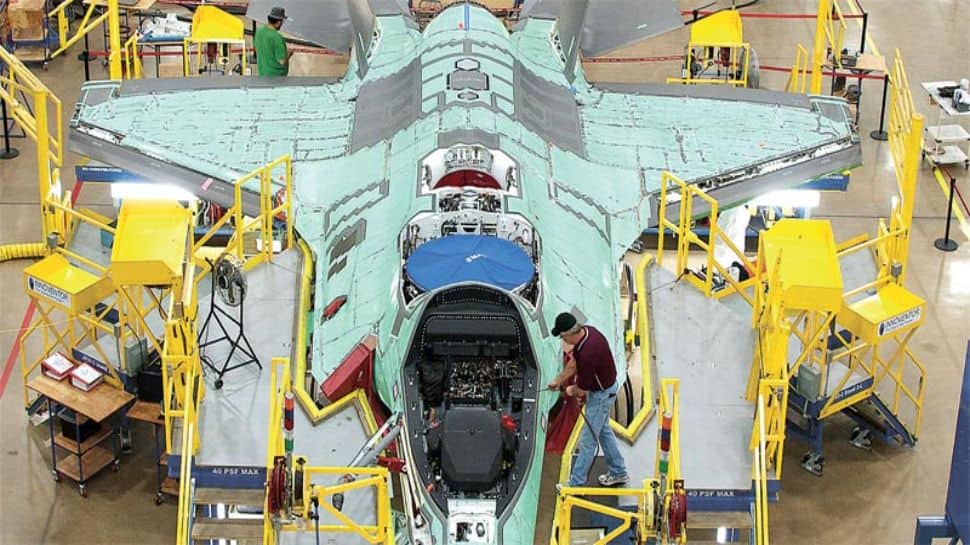
NEW DELHI: US defense manufacturing giant Lockheed Martin, known for making the F-35 stealth jet, has ended 2025 with a production ramp-up that has upended the global fighter jet market and pushed rival plans into the background. Last year, it delivered 191 F-35 jets, setting a new record and comfortably surpassing its original peak of 142 jets.
This pace was a rate of one fighter completed almost every two days, a level of output rarely seen in modern military aviation.
Annual production of the F-35 was running at about five times the rate of all coalition fighters currently in production, according to company data. The pace highlighted how far the program had moved beyond constraints that slowed traditional fighter jet production lines.
Add Zee News as your preferred source

When compared with other major fighter aircraft, the difference became clear. French aerospace company Dassault Aviation has delivered 26 Rafale jets in 2025. The company slightly exceeded its own goal of sending 15 planes to export customers and getting 11 planes into the French military.
Russia’s United Aircraft Corporation delivered seven batches of Su-35 fighters this year. According to the report, each batch included two or three aircraft, and the total number of deliveries to the Russian Aerospace Forces may have been between 14 and 21 aircraft.
Although the exact annual numbers of Eurofighter Typhoons and Saab Gripens have not been officially announced, media estimates indicate that approximately 12 Typhoons and 17 Gripens were delivered during the same period. Combined production of the Rafale, Typhoon, Su-35, Su-34, and Gripen will still fall short of Lockheed Martin’s F-35 production in 2025 alone.
The scale of the F-35 program is rooted in its structure. The Joint Strike Fighter effort was developed with eight partner nations and created a supply chain that spans three continents. Approximately 30 to 42 percent of each aircraft is manufactured outside the United States before final assembly occurs in Texas, according to company disclosures.
Demand is comparable to this industrial range. More than 1,300 F-35s have already been delivered, and total contracts now exceed 3,000 aircraft across 20 countries. This demand puts production lines under constant pressure to expand.
Beyond production numbers, the program achieved several operational milestones throughout the year. F-35 squadrons around the world have accumulated more than 1 million flight hours. Technology Refresh 3, the most advanced software package to date, was also deployed to improve the aircraft’s processing and combat capabilities.
The jet’s role was not limited to training and patrolling. The F-35 saw combat service during multiple conflicts. The aircraft supported efforts to overwhelm Iran’s air defenses during Operation Midnight Hammer and Operation Rising Lion. During the 12-day Iran-Israel war, Israeli F-35I Adir repeatedly attacked Iranian military facilities, flew deep into heavily defended airspace, and completed missions without losses.
F-35s also operated alongside F-22 Raptors at the front of the formation during long-range bombing missions carried out by B-2 stealth bombers. Their mission included establishing air superiority and neutralizing air defenses before bombers entered the conflict zone.
The operational safety figures were also outstanding. While deployed with the U.S. Marine Corps, the F-35B logged nearly 5,000 hours of accident-free flight time. In the NATO operation, F-35s were used to intercept and destroy a Russian drone over Polish airspace, marking the first recorded engagement of a hostile threat by a NATO F-35 within Allied airspace.
Senior executives within the program expressed pride in meeting production goals, maintaining operational performance, and expanding global partnerships throughout the year. The focus was on providing cutting-edge technology to front-line forces to combat emerging threats.
Industry momentum continued to lead to major contracts. In September, the F-35 Joint Program Agency and Lockheed Martin entered into a definitive agreement covering Lots 18 and 19, securing production and delivery of up to 296 aircraft valued at approximately $24 billion. This deal was the largest production contract in the show’s history.
With nearly 1,300 aircraft already in service and actively operated by 12 countries, the F-35 is the backbone of global air power. This fleet currently outnumbers all other fifth-generation fighters combined, including the F-22, Su-57, J-20, and J-35.
Strong demand has resulted in a significant backlog of orders. By the end of the third quarter of 2025, the backlog reached 265 aircraft. The additions at the beginning of the fourth quarter will increase the backlog by an additional 151 aircraft, bringing the total to approximately 416 aircraft by late 2025.
Orders continued to increase throughout the year. Italy has added 25 aircraft to its planned fleet, and Denmark has added 16 more to its program. In the Middle East, the possibility of a new telecommunications carrier beyond Israel has been raised, with the US government indicating a possible sale to Saudi Arabia and Turkey, which have repeatedly expressed interest. Earlier this year, the airline expressed an openness to the possibility of a sale to India, but New Delhi has shown no strong intention to pursue the aircraft.
Sustained production levels appeared to be consistent with political pressure within the United States over defense manufacturing capabilities. Public criticism resurfaced in early January, with concerns raised about production rates, maintenance standards and shareholder payments within the defense industry.
New, modern production facilities and limits on executive compensation were called for until production and readiness issues were resolved. Specific criticism was directed at Raytheon for slow production growth and prioritizing shareholder spending over military needs.
In parallel with fighter jet production, Lockheed Martin announced a major expansion of missile production. The seven-year framework agreement signed with the U.S. Department of the Army on January 6 is aimed at increasing production of the PAC-3 missile segment enhanced interceptor missile. The plan aims to increase the number of missile launches from about 600 to about 2,000 a year over the life of the agreement.
The PAC-3 MSE interceptor missile is already in use by 17 countries, including Sweden, Qatar, Japan, Poland, Saudi Arabia, and Ukraine. Production is increasing, with production increasing by more than 60% in the past two years. Lockheed Martin delivered approximately 380 interceptors in 2023, approximately 500 in 2024, and 620 in 2025.
Taken together, the fighter jet surge and missile expansion highlight a year in which Lockheed Martin not only broke records, but also widened the distance between its own programs and those of its global competitors.
