


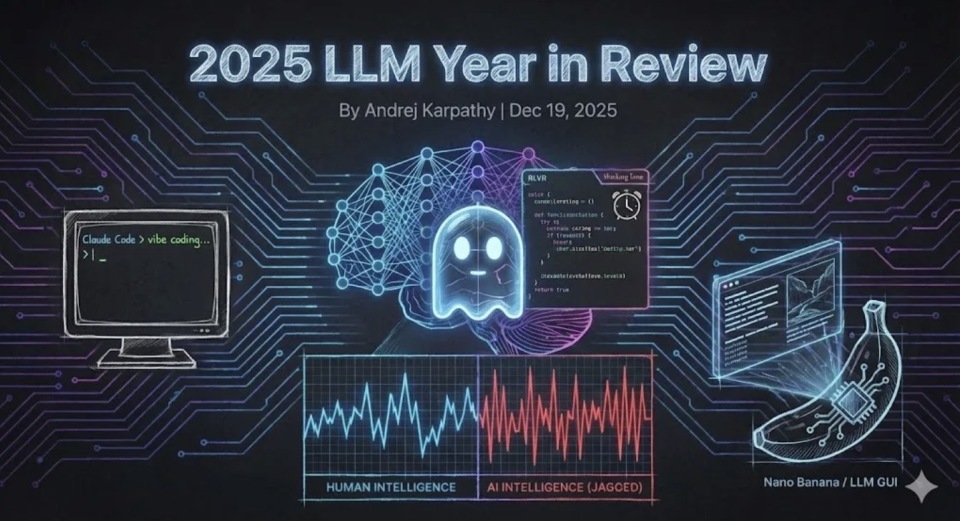
On December 21, Beijing time, Andrei Karpathy, one of the founders of OpenAI and an AI expert, released a detailed annual observation report titled “2025 LLM Year in Review”.
In this review, Karpathy provides a thorough analysis of the fundamental paradigm shift that has occurred in the field of large-scale language models (LLM) over the past year. He pointed out that in 2025, AI training philosophy has made a decisive leap from simple “probabilistic imitation” to “logical reasoning.”
The central driving force behind this transformation comes from the maturation of reinforcement learning with verifiable rewards (RLVR). Through an objective feedback environment such as mathematics or code, the model is made to spontaneously generate “inference traces” similar to human thinking. Karpathy believes that this long-cycle reinforcement learning is starting to erode the share of traditional pre-training, becoming the new engine for improving model functionality.
In addition to changes in the technical path, Karpathy also advocated deep insights into the nature of intelligence. He used the metaphor of “summoning a ghost” rather than “animal evolution/growth” to describe current growth models of AI, and explained why current large-scale language models exhibit “jagged” performance characteristics, i.e., performing like geniuses in cutting-edge fields, yet being as fragile as children in basic common sense.
Additionally, Karpathy detailed the rise of “Vibe coding,” the trend toward practical implementation of localized agents, and the evolution of large-scale language model graphical user interfaces (LLM GUIs). He emphasized that although the industry is progressing rapidly, humanity has currently only exploited less than 10% of the potential of this new computing paradigm, and there is still huge scope for future development.
Karpathy revealed a harsh yet hopeful reality. It means that we are at the tipping point of moving from “simulating human intelligence” to “pure machine intelligence.” With the proliferation of technologies such as RLVR, the AI race in 2026 will no longer be limited to an arms race in computing power, but will move into a thorough exploration of the core logical paradigm of how to make AI think efficiently.
Below is the full text of Kalpathy’s annual review.
“Looking back on the 2025 LLM year”
2025 was a year full of breakthroughs and uncertainties in the field of large-scale language models. Below is a list of “paradigm shifts” that I think deserve special note and are somewhat unexpected. These things have changed the landscape of the industry significantly and have had a huge impact on the thinking level.
01 Reinforcement learning with verifiable rewards (RLVR)
As of early 2025, the production stack for large-scale language models across all labs was essentially:
Pre-Training (GPT – 2/3/2020) Supervised Fine-Tuning (SFT, InstructGPT in 2022) Reinforcement Learning from Human Feedback (RLHF, 2022)
For a long time, this has been a stable and proven solution for training large production-level language models. By 2025, reinforcement learning with verifiable rewards has emerged as a new phase that will become the de facto core of this technology portfolio.
By training large language models in environments with many automatically verifiable rewards, such as math or code puzzles, the models spontaneously form strategies that resemble “reasoning” from a human perspective. They learn to break down complex problems into intermediate computational steps and develop a variety of skills that iterate through reflection and solution exploration (see related examples in the DeepSeek R1 paper).
This type of strategy was difficult to achieve with previous technology paradigms. The main reason is that the model cannot know the optimal inference trace or problem-solving process in advance and must independently explore effective solutions through reward goal optimization.
Unlike fine-tuning stages, such as supervised fine-tuning and reinforcement learning from human feedback, which have relatively low computational requirements, reinforcement learning with verifiable rewards can support longer-cycle optimization processes because it performs training based on an objective (non-cheatable) reward function.
Reinforcement learning with verifiable rewards has been proven in practice to have a very high “power/cost ratio” and can even occupy large amounts of computing resources originally used for pre-training. Therefore, the improvement in the capabilities of large-scale language models in 2025 will primarily come from the exploration and publication of this new stage of “stock potential” by various laboratories.
Overall, there were no major changes in model parameter magnitude this year, but reinforcement learning training cycles were significantly lengthened. Additionally, reinforcement learning with verifiable rewards has also introduced new coordination dimensions (and associated expansion laws). By generating longer inference traces and increasing the “think time” of the model, we can flexibly adjust the amount of computation during the testing phase, thereby achieving increased power.
While the o1 model announced by OpenAI in late 2024 was the first public appearance of reinforcement learning technology with verifiable rewards, the release of the o3 model in early 2025 marked a clear turning point. Until then, people could not intuit the qualitative leap in the capabilities of large-scale language models.
02 The debate between “ghosts” and “animals”/Jagged intelligence
In 2025, I (and I think the entire industry) began to intuit the “shape” of large-scale language model intelligence. What we are facing is not a “gradually evolving animal” but a “summoned ghost.”
All components of the large-scale language model technology stack (neural network architecture, training data, training algorithms, and especially optimization goals) are completely distinct from the evolutionary logic of biological intelligence. Large-scale language models are therefore a new type of entity in the intelligence space. Interpreted from a biological perspective, cognitive biases are inevitable.
When it comes to the nature of surveillance signals, the human brain’s neural networks are optimized for tribal survival and coping with the jungle environment. Meanwhile, the large-scale language model’s neural network is optimized to imitate human text, earn rewards with mathematical problems, and get human likes on LM Arena listings.
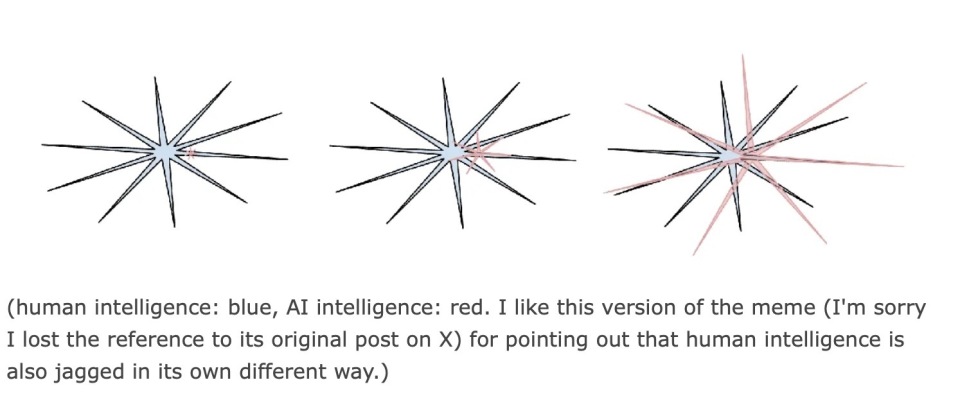
Human intelligence is blue, AI intelligence is red
As reinforcement learning with verifiable rewards becomes widespread in verifiable fields, the capabilities of large-scale language models in these specific fields will experience “explosive growth” and exhibit interesting “jagged performance characteristics” as a whole. They can both be genius polymaths skilled in multiple fields and “elementary school children” full of confusion and cognitive deficiencies. There is also a possibility that the “jailbreak instructions” may induce user data to be leaked.
In this regard, in 2025 I completely lost interest and trust in various benchmarks. The central issue is that the benchmark construction logic is based almost entirely on a “verifiable environment”, making it highly vulnerable to “attacks” through methods such as reinforcement learning and synthetic data generation with verifiable reward training.
In a typical process of “rank brushing”, various laboratories inevitably build mini-training environments near the feature space corresponding to the benchmark in order to cultivate “intelligent jags” that accurately cover test points. Currently, “targeted training of test sets” has become a new type of technical operation.
