


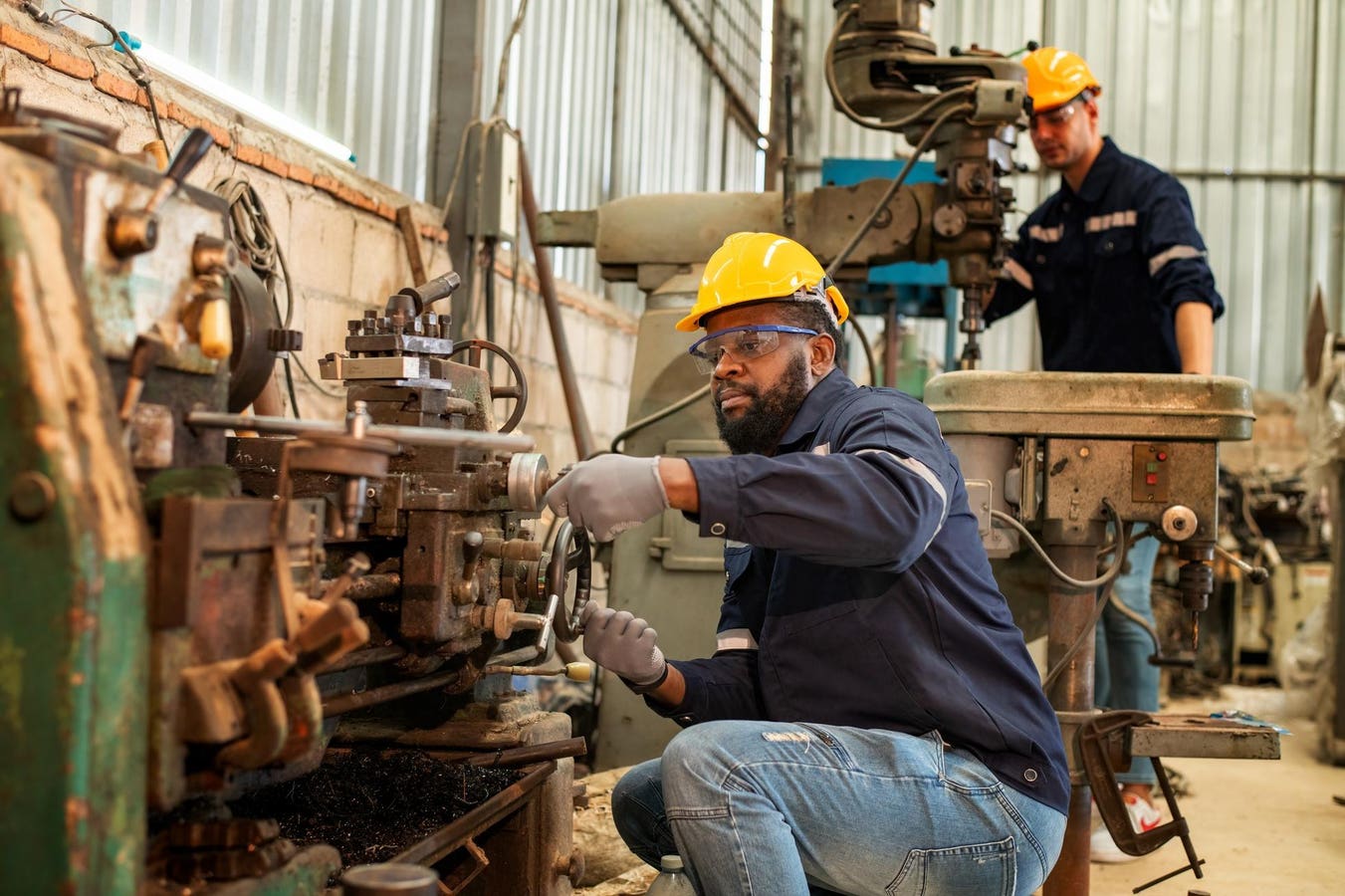

Today’s factory workers are engineers.
getty
There was a time when large-scale computer-driven automation replaced many jobs in the economy. It was the 1970s and 1980s, and computerized machine tools were rapidly gaining popularity, taking over the jobs of assemblers, parts makers, machinists, lathe operators, and more in industrial settings. This wave of automation was driven by intense global competition that threatened to drive many slow-moving manufacturers out of business.
In the process, the economy shifted from manufacturing labor to knowledge labor. Is there anything similar to the way artificial intelligence threatens the jobs of knowledge workers today? A team of researchers from Case Western University, Princeton University, and Brandeis University say that while there are similarities to the automation wave of the 1980s, they only go so far.
In this just-published study, economist and Case Western University professor David Klingsmith and his colleagues argue that workers may not be able to absorb the impact of the current AI wave as quickly as industrial workers in the 1980s because they had strong unions, concentrated influence, and clear retraining paths.
Look at the factory floor today compared to 40 years ago, the co-authors point out. “Modern factory floors are full of machines, but no people.
Computerized machine tools manufacture complex parts based on instructions encoded in computer programs, conveyors move parts from station to station, and robots assemble parts to create finished products. ”
Manufacturing jobs have not completely disappeared, but rather have evolved upwards. Instead of rows of low-skilled assembly line workers, today’s industrial workplaces are staffed with engineers, developers, and product experts. “Factory jobs increasingly require a sophisticated understanding of machine programming and often require a college degree.” Workers had union protection to stave off the initial shock, but they were also drawn en masse to retraining and education programs.
They previously pointed out that: “Machine tools required semi-skilled machinists to manually perform tasks to specifications,” they said. “Automation of machine tools has begun”
Widely popular in the 1970s. New computer numerical control (CNC) tools have replaced these routine tasks with detailed computer programs overseen by skilled workers. ”
Good results, at least at the time, came with increased competitiveness in the global economy. “In the metal manufacturing industry, where the use of CNC tools was high, labor productivity increased with little decline in total employment at either the industry or local labor market level,” the co-authors noted. “Labor demand has shifted from low- and medium-skill workers to college graduates.”
The combination of increased productivity, displacement from core operations, and limited overall employment places CNC between the significant automation advances of early 20th century factory electrification and the more minimal advances associated with it.
Industrial robots today. ”
In other words, the rise of factory automation in the 1980s, with an emphasis on employers providing training and education and opportunities for knowledge workers to grow their skill sets, can be seen as a long-term success story worth emulating in today’s AI environment. Things have changed, but the lesson is that advancements in advanced technology can be the tide that lifts all ships in the long run.
